
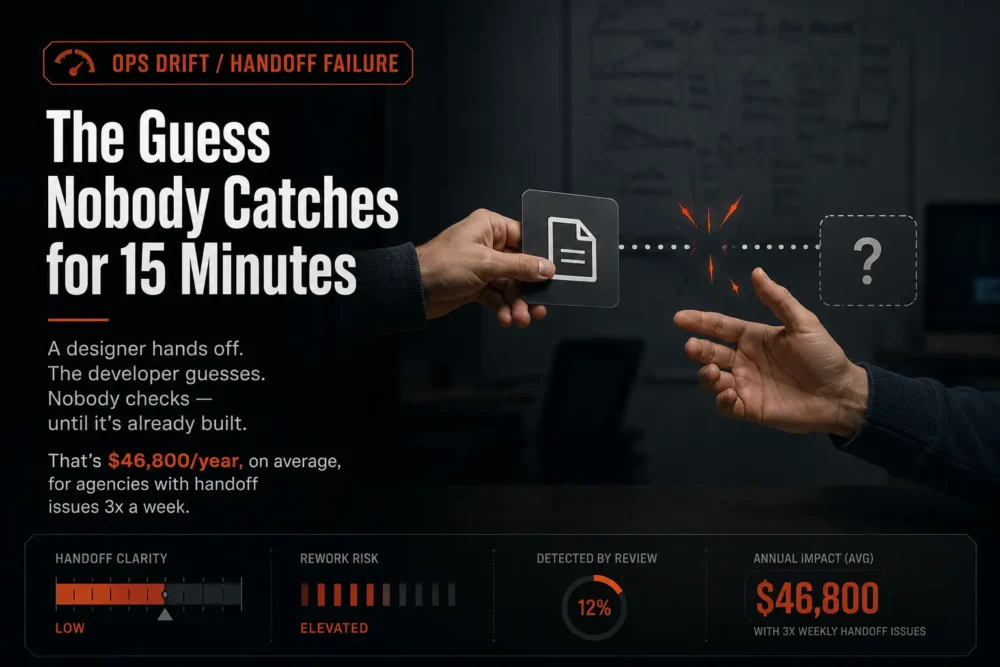
It never looks like a fire. That’s what makes it dangerous.
A designer finishes a homepage mockup and pings the developer: “here’s the file, questions in Slack.” The developer has a question about spacing on the hero section but the designer’s already heads-down on the next project. So the developer guesses. Fifteen minutes later, the guess is wrong, but nobody knows it yet — it just gets built.
That’s the whole incident. Five minutes, maybe less. No one missed a deadline. No client got a bad email. On the daily standup, it doesn’t even come up. It’s not a big enough deal to name.
But it didn’t end there. It never does.
The handoff isn’t a moment — it’s a multiplier
Most agency owners think of a handoff as a single event: file passed, ticket assigned, task moved to the next column. In reality, a handoff is a compression point. Everything the first person knew — the client’s real intent, the constraint that got waved away in a call, the “we tried that already” — has to survive being squeezed through a Slack message, a Loom, or a one-line ticket description. Most of it doesn’t make it.
What comes out the other side isn’t the work. It’s a guess dressed up as the work.
And a guess that’s wrong doesn’t announce itself. It moves downstream, picking up more work built on top of it — a dev builds on the wrong spacing, QA signs off because it “looks right,” the account manager sends it to the client because it’s marked done. By the time someone flags it, you’re not fixing five minutes of drift. You’re unwinding three people’s worth of hours, and probably a client conversation nobody wants to have.
This is what compounds. Not the mistake — the distance between where the mistake happened and where it’s finally seen.
Where the cost actually lands
Profitability. Rework doesn’t show up as a line item called “rework.” It shows up as scope creep on a fixed-fee project, as hours that quietly don’t bill, as a project that was profitable on paper and wasn’t in practice. Ask most agency owners how many hours per project go to redoing something that was handed off wrong the first time, and they’ll guess low — because it’s distributed across ten small corrections instead of one visible failure.
Growth. Every hour spent re-explaining is an hour not spent on the next client. Worse, handoff drift caps how much work an agency can safely take on, because more volume means more handoff points, and more handoff points means more chances for a five-minute gap to become a two-day fix. Owners feel this as a ceiling — not “we don’t have capacity,” but “we can’t grow past this without it breaking somewhere we can’t see yet.”
Staff morale. This is the one that erodes quietest. Nobody enjoys redoing work they thought was finished. Nobody enjoys being the person who has to say “actually, that’s not what the client asked for” three days after it shipped. Over time, the team stops trusting handoffs at all — people start over-explaining, over-documenting, double-checking work that shouldn’t need it, because the alternative has burned them before. That’s not a process improvement. That’s defensive behavior, and it’s slow and expensive in a way that never shows up on a dashboard.
Why it stays invisible
The reason handoff drift survives is that nothing about it looks broken in the moment. Everyone involved did something reasonable: the designer moved on because they had other work, the developer guessed because asking felt like it would slow things down, the account manager sent the file because it was marked complete. No one cut a corner. The system just didn’t carry the context far enough, and nobody was positioned to notice until the cost had already compounded three or four handoffs downstream.
This is the pattern that separates ops drift from an actual operational failure. A failure gets noticed and fixed. Drift gets absorbed — by margin, by timeline, by the people doing the absorbing — until it’s just how the agency runs.
What it looks like when it’s not happening
Agencies that don’t bleed here usually aren’t doing anything heroic. They’ve just made the handoff itself a checkpoint instead of a formality — a beat where the person receiving the work confirms they understood it, not just received it. It costs a few minutes. It’s the same few minutes that, skipped, is where all of this started.
The hard part isn’t knowing this is true in general. It’s knowing where it’s happening in your agency specifically — which handoffs are silently costing you the most, and whether it’s concentrated in one stage of the build cycle or spread everywhere.
That’s the read OpsDriftCheck is built to give: a 4-minute diagnostic, no pitch attached, that shows you where drift is actually sitting before it shows up in your margins. Take it at opsdriftcheck.com.